


Your shopping cart is empty!
Chinense chives "Piquant"
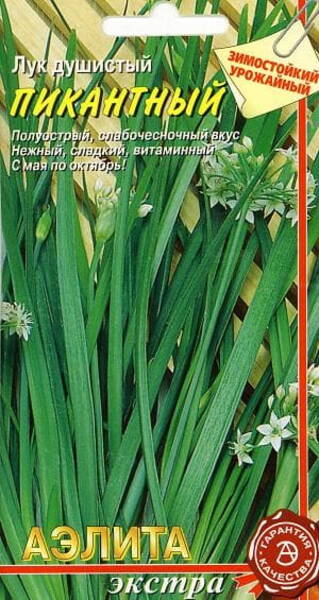
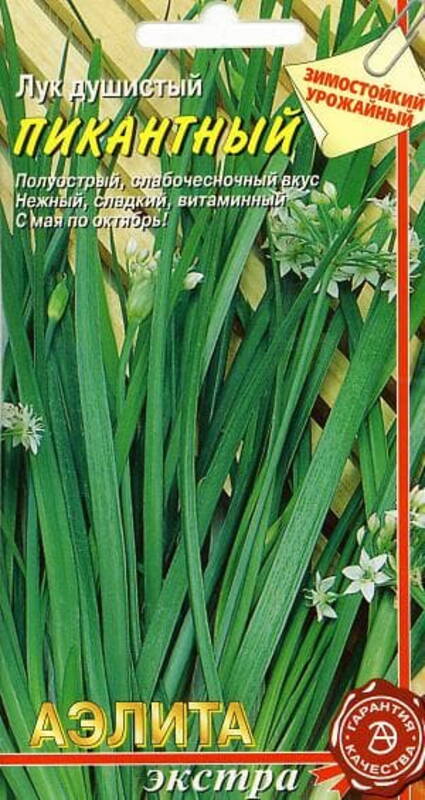
Fragrant Onion "Piquant" - Allium odorum.
Mid-season (55-60 days from germination to green harvesting), winter-hardy variety of perennial onion. Leaves are dark green, flat, triangular, juicy and tender without sharpness, with a light garlic flavor, 30-35 cm long, 0.9-1.1 cm wide. Ascorbic acid content 85-89 mg%, characterized by a low fiber content, so the leaves do not become coarse until late autumn. Flowering plants have a pleasant hyacinth aroma. Green harvesting begins in the second year, 2-3 times per season. Yield with a single harvest is 1.3-1.5 kg/m2, with multiple harvests up to 2.7 kg/m2. Sowing in open ground: April - May. Harvesting: July - August. Planting scheme: 20x30 cm.
Name: worldwide it is called Chinese chives. In Southeast Asia, the scientific name of the species is Allium tuberosum. It was given due to the similarity of its fragrant flowers to the flowers of a well-known plant from the amaryllis family. In Russia, the name fragrant onion (Allium odorum) is assigned to this wonderful type of onion. Most botanists, however, tend to combine the above species into one - Allium ramosum.
Description: apparently, fragrant onion was introduced into culture in China and in this capacity ended up in Japan, where it became a national favorite. In nature, fragrant onion is found in the mountains of Mongolia, Central Asia, Altai, in the southern part of Western and Eastern Siberia. It grows on rocky slopes of the middle and lower mountain belts, on hills, meadows with saline soils, in the valleys of mountain rivers that dry up in summer. This is a fairly thermophilic plant that grows back in spring after a stable period of positive temperatures. At the same time, fragrant onion is winter-hardy and tolerates frosts down to -45 °C, even with a shallow snow cover.
Mid-season (55-60 days from germination to green harvesting), winter-hardy variety of perennial onion. Leaves are dark green, flat, triangular, juicy and tender without sharpness, with a light garlic flavor, 30-35 cm long, 0.9-1.1 cm wide. Ascorbic acid content 85-89 mg%, characterized by a low fiber content, so the leaves do not become coarse until late autumn. Flowering plants have a pleasant hyacinth aroma. Green harvesting begins in the second year, 2-3 times per season. Yield with a single harvest is 1.3-1.5 kg/m2, with multiple harvests up to 2.7 kg/m2. Sowing in open ground: April - May. Harvesting: July - August. Planting scheme: 20x30 cm.
Name: worldwide it is called Chinese chives. In Southeast Asia, the scientific name of the species is Allium tuberosum. It was given due to the similarity of its fragrant flowers to the flowers of a well-known plant from the amaryllis family. In Russia, the name fragrant onion (Allium odorum) is assigned to this wonderful type of onion. Most botanists, however, tend to combine the above species into one - Allium ramosum.
Description: apparently, fragrant onion was introduced into culture in China and in this capacity ended up in Japan, where it became a national favorite. In nature, fragrant onion is found in the mountains of Mongolia, Central Asia, Altai, in the southern part of Western and Eastern Siberia. It grows on rocky slopes of the middle and lower mountain belts, on hills, meadows with saline soils, in the valleys of mountain rivers that dry up in summer. This is a fairly thermophilic plant that grows back in spring after a stable period of positive temperatures. At the same time, fragrant onion is winter-hardy and tolerates frosts down to -45 °C, even with a shallow snow cover.
HEALING AND TASTE QUALITIES
Fragrant onion is very popular as a green crop also in Korea, India, Nepal, Thailand and the Philippines. Leaves and flowers are used for food, and all parts of the plant are used in phytotherapy. In treatises on ancient Indian, Chinese and Tibetan medicine, fragrant onion is mentioned as a highly effective remedy for overwork, depression, and vitamin deficiency. Doctors prescribed it during the recovery period after poisoning and severe illnesses. In occult eastern systems, fragrant onion is considered a means of protection against demons of the upper spheres.
The leaves of fragrant onion should be tender and juicy dark green in color. In Japan, the quality of greens is determined by the presence of a weak garlic aroma and the length of the leaves: the highest grade - leaves 23-28 cm long, 18-22 cm - good quality and 15 - 17 cm - medium. In China, bleached fragrant onion is also grown - lightly colored tender leaves, practically without sharpness. In the field, plants are protected from light with awnings, straw mats, dark paper, etc.
Fragrant onion is used mainly raw, since up to 80% of vitamin C is lost during processing. Its juicy leaves lose their freshness and vitamin reserves quite quickly, they can be stored for no more than 2-3 days at a temperature of 0 to 2 °C.
Even in small quantities, fresh greens of fragrant onion stimulate appetite, increase the secretion of digestive juice, and contribute to better absorption of nutrients by the body. Green leaves contain up to 3% sugars, are rich in vitamin C, carotene, mineral salts, especially calcium and iron salts, vitamins B1 and B2. In cooking, it is widely used to decorate dishes, as the main component of salads with various sauces, as well as in salads with other vegetables, eggs, fish, and seafood.
Thanks to its dark green leaves resembling juicy grass and loose openwork umbrellas with fragrant, white, star-like flowers, fragrant onion is very attractive. Therefore, at all times it was grown as an ornamental plant, and the flowers were used for bouquets. As an ornamental plant, fragrant onion looks very beautiful in mixborders, in groups on lawns, and low-growing forms are indispensable for rock gardens. It is also an excellent honey plant, and the honey from it has neither an onion smell nor taste.
BIOLOGICAL CHARACTERISTICS
Fragrant onion is a long-growing perennial plant, propagated by seeds and dividing the bush. The rhizome, similar to the rhizome of bearded iris, branches quite strongly, forming dense clumps. Thick roots extend from the lower part of the rhizome, which penetrate the soil much deeper than the roots of onions and garlic, so soils with a deep arable horizon are preferred for this plant.
The bulbs are narrowly cylindrical or narrowly conical, weakly expressed, covered with dark brown reticulate sheaths; in some varieties, the bulbs increase in diameter with age. However, in all forms, the main storage organ is not the bulb, but the rhizome.
Leaves are flat, 0.5-1.0 cm wide, slightly keeled, tapering towards the top. The process of formation and growth of leaves continues from spring to autumn, a new leaf appears every 8-10 days, starting from the second half of summer, the process of drying out of the leaves occurs simultaneously.
The inflorescence - a hemispherical tufted umbrella - is located on a high (30-80 cm) straight peduncle, oval in cross section, with two sharp ribs. Before flowering, the inflorescence is covered with a pointed sheath, which, having broken, remains at its base.
The flowers of this species are very fragrant. The petals of the perianth are snow-white on the inside, and dirty pink on the outside with a central dark green vein. Each bulb forms from two to four inflorescences per year. Flowering of an adult plant (older than 3 years) begins in mid-July and lasts until autumn frosts. On it you can simultaneously see both flowering umbrellas, and inflorescences in sheaths, and seed boxes opening or with ripe seeds. The main mass of leaves accumulates on the plant by the beginning of flowering. Seeds ripen from mid-August. They are round, black, shiny.
Seeds are collected from flowering 3-4-year-old well-developed plants. Umbrellas are cut with peduncles about 30 cm long, after drying they are threshed and cleaned. Seeds do not retain viability for long, so they are usually sown in the spring of the following year.
GROWING ON THE SITE
All aspects of the quality of greens depend on the conditions of culture. For the development of fragrant onion plants, the optimum temperature is 20 °C, but it grows normally at lower temperatures in the temperate climate zone. Fragrant onion is well adapted to many types of soils, but on fertile, well-fertilized lands it adapts better in any climatic zone. In the homeland of fragrant onion, methods of its cultivation have historically developed, which can serve as the basis of agricultural technology in any climatic zone with appropriate adaptation to growing conditions.
In Northern China, fragrant onion is traditionally grown in perennial culture from 7 to 30 years. Seeds are sown in spring to a depth of 1 cm, in four furrows. In the first year, plants are watered only in case of extreme necessity, in order to obtain a developed root system and the leaves are not cut. The following year, in early spring, dead leaves are removed, the plants are hilled at the base of the shoots and the rows in the furrows are sprinkled with a 4-6 cm layer of sandy soil to obtain bleached false stems. After the leaves grow back, the rows are thinned out, forming the necessary distance between the plants. You can also transplant plants from a seedling bed to a permanent place. In this case, seedlings are placed in ribbons of 4 rows; the distance between rows is 35 cm, between plants in a row is 16 cm.
Starting from the second year, three cuts of leaves are carried out per season (when the plants reach 20 cm in height) with an interval of 20-30 days, at the end of summer the cuts are stopped. In late autumn, the beds are harrowed. To remove old and dead roots, mulch the soil around the plants with a 1-5 cm layer of loose humus. Top dressing is carried out after cuts. Transplantation and division of fragrant onion bushes are carried out in spring, since in early autumn the plants are still flowering and therefore take root